Join My Mailing List!

My name is Jacqueline T. Lynch, author of Ann Blyth: Actress. Singer. Star.,
and I would like to invite you to join my mailing list HERE for updates, special offers, and a free eBook!

Wednesday, January 23, 2019

Ann Blyth feeds fellow cast member on set of KISMET


Ann Blyth appears to be feeding a castmate some lunch while on the set of Kismet (1955).  You can next see this lavish musical on Turner Classic Movies tomorrow, Thursday the 24th at 6 p.m. ET.


Ann’s most famous number, “Baubles, Bangles, and Beads,” is a slow waltz-tune during which she changes from a ragged street urchin to desirable woman.  A bolt of yellow cloth is chucked across the screen and she catches it, like grabbing the brass ring... 


Could she have ever imagined while lip-syncing that lovely tune to the playback of her lovely voice on the faux Persian soundstage that she’d still be singing it in concert decades later? 

eBook edition (Amazon)


Also available in eBook at:


Wednesday, January 16, 2019

Ann Blyth's early studio publicity photos


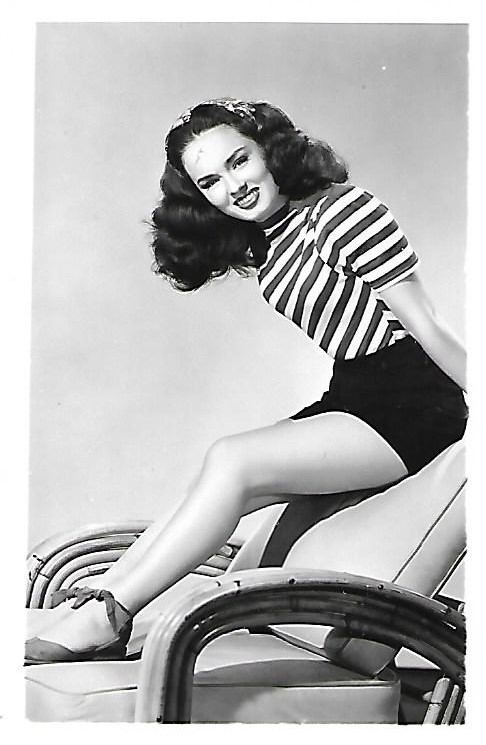
Ann Blyth was likely around 15 years old at the time this series of publicity photos were taken.  One of the first actions a Hollywood studio, in this case, Universal, took upon signing a new talent for their roster was to experiment with the actor's appearance.  Beginning a 7-year hitch with a studio could be a daunting experience for any young actor or actress.  It must have been confusing to discover upon reaching the makeup department that what the studio really wanted must be somebody else entirely.

From my book on Ann Blyth's career, Ann Blyth: Actress. Singer. Star.:

An early publicity photo from this time shows Ann standing on the steps of a train passenger car, posed rather stiffly, smiling dutifully, but perhaps a little nervously, for the camera.  The bright sunshine floods her features, and with glare that head Universal still photographer Ray Jones would surely not permit in his studio.  She is dressed in the proper little girl attire of the day: a long-sleeve dress and pinafore falling just above the knee, white ankle socks and Mary Janes, an enormous bow perched on the back of her head, clutching a small purse.  She looks like she might be coming to visit Grandma.  She is fourteen years old.

It’s hard to imagine in two years she’d be seducing Zachary Scott before shooting him, and slapping Joan Crawford—only on film, of course.

Universal press agent, Frank McFadden, recalled for Photoplay magazine in 1956 when he first met Ann Blyth and her mother at Los Angeles’ Union Station when she arrived to begin her seven-year contract with the studio.

“She was just a sweet little girl holding her mother’s hand, a little afraid—it seemed to me.  I took them out to the Hotel Knickerbocker, and since their room wasn’t ready, we drove around a little while and I showed them the sights.  I thought she was just another pretty child coming to Hollywood then.” 


They gussied up -- one might say for these photos, "hussy-ed up" their new acquisition for the test photos, but quickly changed tactics and put her in four innocent roles in four teen musicals before she got a chance at playing the wicked Veda Pierce.  And she didn't need a lot of makeup and provocative poses for that; she just had imagination and talent.


eBook edition (Amazon)


Also available in eBook at:


Wednesday, January 9, 2019

Brute Force with Ann Blyth and Burt Lancaster


Brute Force (1946), a powerful prison drama starring Burt Lancaster as the inmate planning a daring escape to reach his love, Ann Blyth, in time airs today on Turner Classic Movies, 3 p.m. ET.  From my book, Ann Blyth: Actress. Singer. Star.:

Ann is at first asleep, then he wakes her, and in their tender scene shows us that Lancaster is tired of running, that this will be his last job, and then he will come back to her for good.  He tells her that when he met her, he was a guy who “found the first important thing in his life.”  She doesn’t know what racket he’s in, but she senses he is troubled.  She wants to help him, wishes she weren’t sick so that she could help him.

“There are all kinds of sick people, Ruth.  Maybe we could help each other.”  The scene is gentle, affectionate, somewhat sad.  Ann’s character is not a gun moll; she’s a sweet, decent girl who trusts him.  This is important because it bolsters the visual image we already have of Burt Lancaster in the film as more a wounded animal than a psychopath.  


Wednesday, November 28, 2018

Ann Blyth on Movie Spotlight cover


Ann Blyth appears on the cover of Movie Spotlight magazine from April 1954.  There was a proliferation of magazines from the 1930s through the 1950s exclusively  devoted to Hollywood movie stars, so efficient was the industry publicity machine and the public's fascination.  Ann was featured on a number of covers and in many articles in those years.

I don't believe any of the magazines that were part of that era are published today.  Though celebrity watching is hardly diminished, it is certainly less glamorized.  


Wednesday, November 14, 2018

Ann Blyth dumps porridge on Howard Keel's head


Ann Blyth dumps a bowl of porridge on Howard Keel's head.  How many times in how many takes?  For her sake, I hope it was at least a few, because it looks like fun.

Here Ann starred with Howard Keel in the lavish musical Rose Marie (1954).  From my book Ann Blyth: Actress. Singer. Star.:


Sgt. Howard Keel catches her again.  Have a look at the image of him holding her, one-armed, from his horse, dangling her like a rag doll.  An indignant, frustrated rag doll.  There is no remnant of the slick sociopath Veda Pierce.  Nothing resembling the haughty, conniving fashion plate Regina Hubbard, the graceful elegance of the Countess Marina, and no sign of the poised, demure high school graduate Gail Macaulay.


Few of Ann Blyth’s contemporaries were as versatile.  Catch the little groan, equal parts despair and discomfort, when he hoists her into the saddle after she capitulates.


Howard Keel at first was not happy with the Mountie’s role in this film, finding him too weak and ineffectual…perhaps as clownish as Dudley Do-Right…but his requested changes to the script were made and he signed on, noting in his autobiography, Only Make Believe, that it was a fun shoot.


I didn’t sing with Ann Blyth, but she was a delightful cutie and sang beautifully.

Wednesday, October 17, 2018

Ann with Don Ameche on Quincy, M.E.


Ann Blyth with Don Ameche and Ron Masak in a publicity photo for a 1979 episode of Quincy, M.E.  From my book, Ann Blyth: Actress. Singer. Star.:


“The Death Challenge” brings together Ann and Don Ameche (with whom she appeared on TV in The Triumphant Hour in 1954) as a show-biz couple on whom the glare of the spotlight is focused after a long period of being ignored.  They also attract the attention of the police and our intrepid medical examiner, Quincy, played by Jack Klugman, when a stunt goes terribly wrong.


It’s the first of two episodes of the TV program Quincy, M.E. on which Ann appeared.  One of the sublime joys of episodic television in the 1970s and 1980s, for lovers of classic films at least, is that a huge roster of players from Hollywood’s heyday took their final curtain calls as guests on these shows...  


Wednesday, October 10, 2018

Ann with Fernando Lamas - ROSE MARIE (1954)


Ann Blyth appears in the above publicity photo with Fernando Lamas.  The film is Rose Marie (1954), a glorious CinemaScope color movie that casts a new spell on an old-fashioned hit.  

From my book, Ann Blyth: Actress. Singer. Star.:


Ann Blyth was twenty-four going on twenty-five when she played the title role in this musical, and one is impressed by her ability to appear so young, so naturally and effortlessly a teenager when in her teen years she often played characters who were older, or least more poised and sophisticated.  Very light, natural-looking makeup, a tan, and her loose woodsman’s buckskins covering her shape help to create this illusion, but two things she does herself complete the picture—her animated expressions which, with the innocence of youth, do not mask her emotions, but let us see every flickering thought passing through her mind, and also the way she moves.  With an animal-like ease and strength, she lives the outdoor life like someone completely at home in the woods, not stomping about in her buckskin with exaggerated mannishness like Doris Day in Calamity Jane, but hiking, climbing on rocks, and running with the grace of an athlete. 


The picture of her seeming physical change was overshadowed in the press of the day, which took greater notice, with greater surprise, at her singing voice.  This was her first big singing role after her one song in The Great Caruso.  A review in the St. Petersburg (Florida) Times:


The surprise in Rose Marie is Ann Blyth’s singing voice, which is gloriously pitched, full, and strong.


The “new Ann Blyth” of the headline “New Ann Blyth Emerges in Classical Rose Marie,” (in pretty much every film she did she was always “new”), emphatically declares herself with her first song, the exhilarating “Free to Be Free.”  Just like the character Rose Marie, who wants to live life in the wild without being forced into a “ladylike” life of restricted freedom in town, Ann Blyth is declaring her freedom in a way that says, “Look at me.  I can really sing.  This is my movie.”  Her range is quite demonstrably large in this song, even drifting down into the mezzo area, and her control is stunning, bang-on notes with no vibrato or trilling.  It’s a magnificent delivery and a great song to come charging out of the gate in this movie, as if to make the audience take notice—this is Rose Marie, the old chestnut you thought you knew, but didn’t.